
In the spring of 2015, for my sociocultural anthropology course, I did an assignment about my friend group in university. It was the second semester of my third year. “How do you understand the ongoing construction (the re-creation) of your unique identity through group behaviour?” was the question I was supposed to be addressing through an academic paper and a photo-ethnography. I got 100% on both, never told any of my friends about it, put the photographs and the accompanying paper into a big khaki envelope, sealed it and decided I wouldn’t open it for at least 10 years.
The paper was the final project for the first of four courses I would end up taking with Dr. Julie Flowerday (in retrospect she may well be the reason I graduated with so many sociology credits that it became my accidental minor). My friend once commented that Dr. Flowerday is ‘Yusra if she was 35 years older, and white.” She was a delightful teacher, her readings were challenging and her lectures brilliantly lucid. The assignment was not restricted to writing about one’s social group - that was prompt I opted for over others. My third year of university was a time my mother was frequently travelling for work, so naturally, I was frequently hosting secret dinner parties at my house. For the photo narrative, I decided what would be both most fun and most convenient was documenting the process of preparing for and hosting one of these dinner parties.
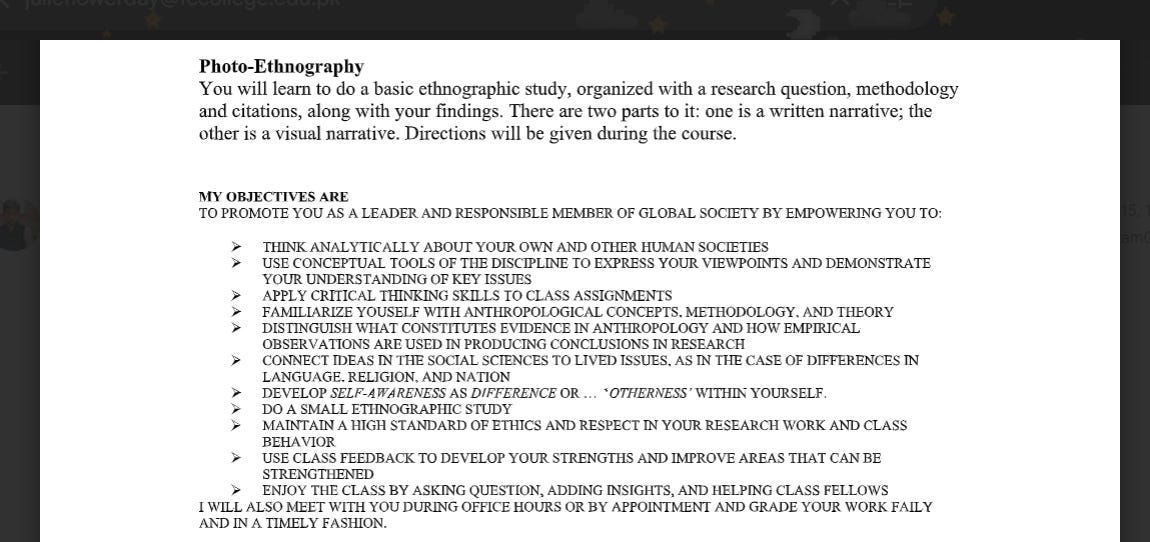
a page from Dr. Flowerday’s syllabus
Last month, my university friends had ourselves a little bit of a reunion, the catalyst for which was a friend who has immigrated visiting Pakistan for the first time in six years. Some of us hadn’t talked in years, some of us are in a group chat together, some of us reconnected recently. Three of the original friend group no longer live in Pakistan. One of them isn’t in my life anymore, while another classmate who wasn’t as close to us in university is. And so I left my new little apartment in Islamabad and returned to Lahore for two weeks to revisit the past and ponder what it had gifted to the present and what it may lend to the future. To meet some of my oldest friends, together, for the first time in years.
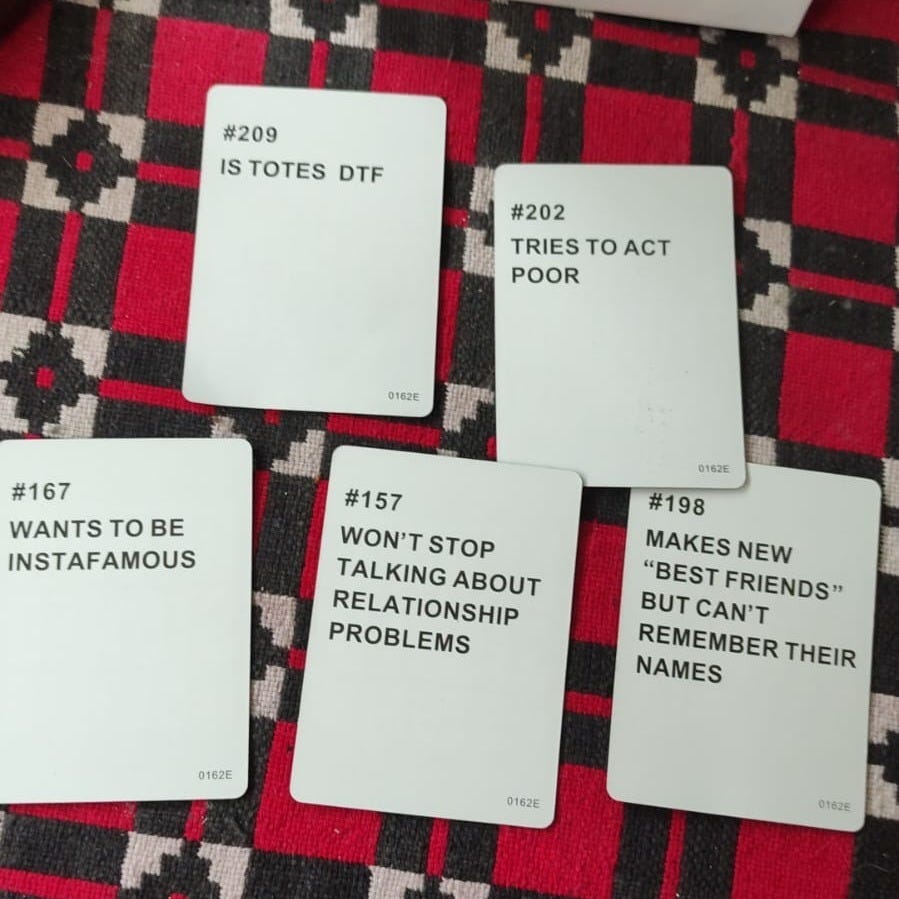
One of the funniest things that happened during our unofficial reunion week was me spectacularly (and UNFAIRLY, might I add, as my friends REFUSED TO FOLLOW THE OFFICIAL RULES) losing a party game that I had excitedly brought for us to play. It involved drawing cards printed with vaguely derogatory descriptions and “awarding” them to each other. Whoever gets the most cards loses - in this case me. One of the cards awarded to me read “Always Making New Best Friends Whose Names They Can’t Remember”. I do not consider myself a popular person for the same reason I do not consider myself an astronaut: I am in touch with reality. The realisation that I have an inordinate number of friends compared to my peers has been a slow and surprising one. “You have so many friends,” my ex-best friend said to me the night i left for my Fulbright, witnessing the number of people who came to say goodbye before my flight. “I don’t have any!” she added ruefully. “How do you have so many friends at our age?” asked someone four years later, at my 31st birthday party.
The answer isn’t particularly interesting or complex. I am not especially charismatic. I just love friendship; it’s my favourite alchemy. I’m that girl in Mean Girls who just has a lot of feelings. Maybe its because my sun moon and mercury are in the 7th House or because my Jupiter is in Libra. I think I wrote that paper for the same reason I’m interested in astrology: I want to understand how and why certain people get along with each other, and how and why they don’t.
How much of friendship is chance, for example, and how much is intention? The first person to ever know about this paper was ironically the friend I was least close to in university (unsurprisingly the only cishet male in the group). Why? Because sometimes life is random. We’ve laughed more than once about the fact that we would never have been friends (most of mine are women) were it not for circumstances forcing us to interact (he was dating my friend). The truth is that there is no one thing we all have in common, except perhaps an illegal predilection, something I observe in the paper itself. The truth is that since we graduated, almost all of us have stopped talking to each other for some amount of time, for a wild variety of reasons. The truth is none of my university friends were really around at 25, the worst year of my life, when I lost my father and brother. We’ve wandered in and out of each other’s lives, and somehow still ended up back in the same room. And that’s not random, because communication is a choice, and forgiveness is a choice, and the allocation of our time is a choice. The truth is I wrote that paper because I was fascinated by the arbitrariness of friendship; how and why people randomly choose to care about each other, without any familial obligations holding them together.
Even writing this paper was not just an act of love or analysis - it was an act of care. I told my professor I absolutely could not submit the paper over email as per standard protocol. I explained to this white American woman that given some of the things I was revealing (not to mention some of the photos), and the society we lived in, and its various laws, written and unwritten, I absolutely did not want those words to exist eternally in someone else’s inbox - it was simply too much of a risk to me and my friends’ safety and too much of a betrayal of their trust. Dr. Flowerday listened and agreed to my demands with a touching seriousness, telling me I was thinking like an ethnographer and reassuring me that even the hard copy of the paper would be under lock and key in her office until she graded and returned it. It was one of those rare moments of True Learning that sadly occur rarely in our formal education - i could sense her pride at seeing me engage in real time, in real life, with what she had been trying to teach us: the ethics of analysing and documenting our fellow humans.
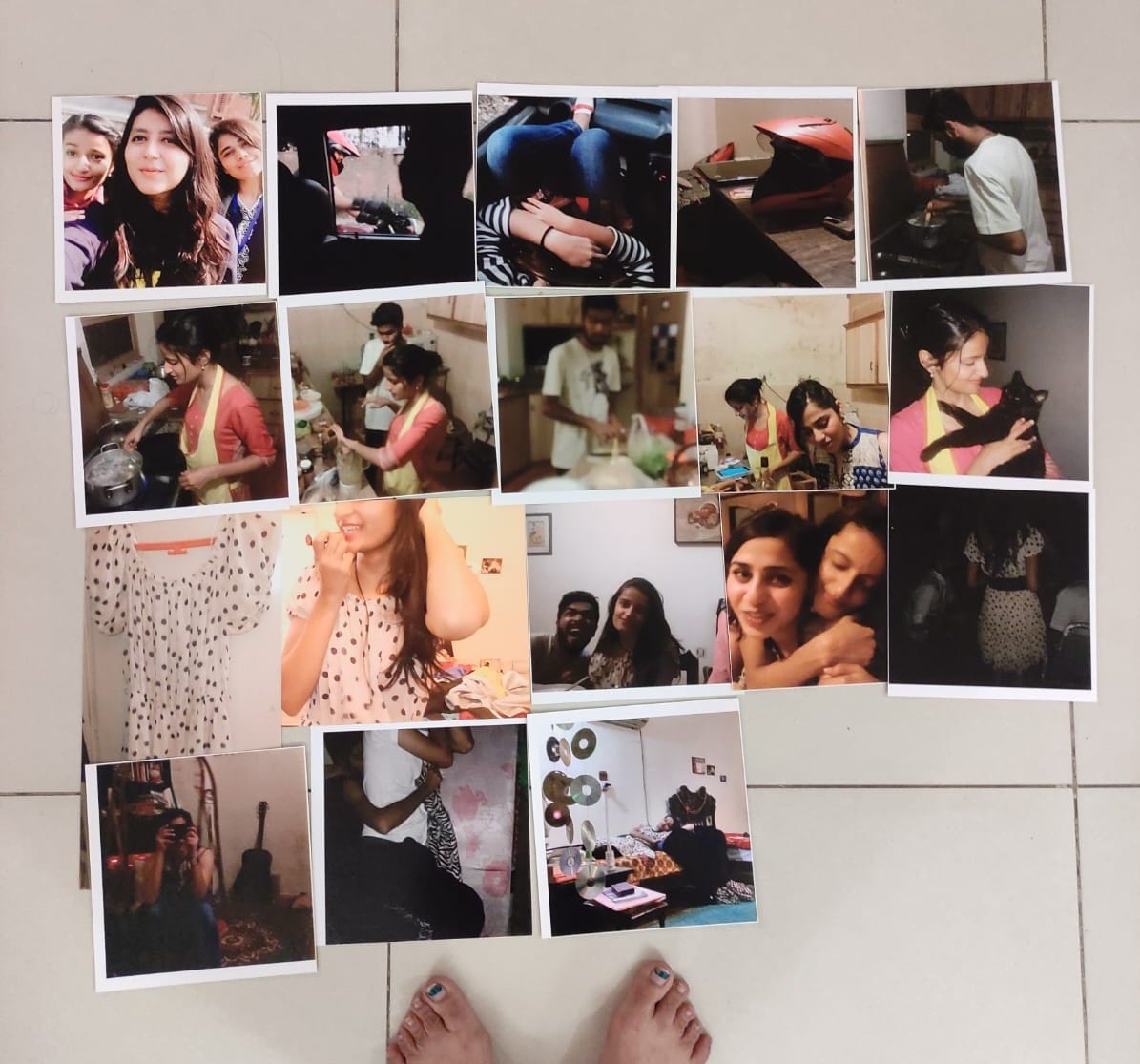
Like your average English major, I suck at anything quantitative and excel and anything qualitative, so I loved putting together the photoethnography, curating pictures of me, my friends, and our POVs into a narrative. Today, as I remove each of the 18 photographs, numbered in black marker, from the khaki envelope and lay them in order on the floor of my first independent apartment, I can still read the story I tried to tell ten years ago. Z, S and me in a selfie outside the science block, taken on Z’s iphone 5 - you can tell because of filter. A photo of D in his red helmet on his motorbike, taken from inside M’s car, the backpack containing freshly acquired accoutrements for the evening just out of frame. My friends and I in my kitchen, cooking. My black and white polka dot party dress on its hanger. A gorgeous, cinema-verité-esque shot in the garden: my back to the camera, the monochrome chiffon of my dress in the foreground, the stark white shirts and darkly lit faces of the two boys smoking in the background. And the last photo: me at the end of the dinner party, lying back content on one of the twin beds in the last room I ever shared with my big sister, the “curtain” we had made by tying old CDs onto strings and dangling them from the ceiling glinting in the foreground.
Maybe friendship is fundamentally an act of bearing witness.
There’s this line at end of the latest season of the White Lotus that hit me right in the heart:
”I don't need religion or God to give my life meaning. Because time gives it meaning. We, we started this life together.” - Laurie, The White Lotus
As you’ve probably guessed if you know the premise of the show, my friends and I couldn’t be more superficially different from the character who utters this dialogue. She is one of a trio of wealthy blond heterosexual besties on a midlife crisis-themed vacation at one of the most expensive resorts in the world. We are third world kids of mixed genders and sexualities from backgrounds of varying socioeconomic privilege. Some of us were almost married off instead of getting to attend university. Some of us have been working since we were 18. Some of us put ourselves through college. But the magic of good writing is in its universality: time does give us meaning. I’ve known D since he was working in a corner shop and coming to uni on his motorbike; he now drives a Mercedes and lives in an unreasonably huge bachelor pad (say mashallah). When I met C, she wore hijab, and now her distinctive curls have become such a big part of her public identity that even her instagram handle alludes to them. I have known Z since she was a 20 year old living in a traumatic household and coping with an infertility diagnosis. I’ve known her since she was cuddling her boyfriend secretly in my house so her parents wouldn’t find out. Last month she hosted all of us for lunch in the perfect little house where she lives with that boyfriend, now her husband, and her perfect two year old daughter (I don’t mean to brag, but I’m TOTALLY the favourite nonbiological aunt already).
Despite her being my senior, M and I were close friends in university. She sought me out because she already knew my big brother, who had told her to look out for me. She was one of the first people to message me when I posted about his funeral. Last month was the first time she returned to Pakistan since his death. When we were chatting about her impending trip, she mentioned that she’s gotten into making perfumes for herself and her friends. M, S, and me, we all love perfumes. In our uni days, she and S used to give me perfumes and makeup and clothes their aunts sent from abroad, exchanging imported products according to what suits who best. M asked me if I’d like a bespoke perfume; I was thrilled. “And don’t tell me what kind. I know what kind,” she said over Whatsapp. I now have the perfume in my bag (it’s named “manic pixie dream girl” after the trope that has plagued my love life for a decade). It’s perfect; smoky, spicy, sandalwoodsy, rose-heavy. When I sampled it for my mother, she smiled and said “oh, that’s so you!”
And it is, because M knows my smell, because we were girls in university together. I smell the same but I am not and neither is she; the girls we were ten years ago no longer exist except in each others’ memories, where they are immortalised. I said earlier that I lost the game where you award each other rude titles; technically, that’s not true. The real loser of the party game (ironically given to me by one of the “random new besties” my old friends were teasing me about) was someone who was not even in the continent: S, our most endearingly unhinged friend, who moved to Canada in 2019. We drew card after card that said something like “loses keys while driving” or “gets trapped by revolving door” and collectively laughed, “oh, that’s so S!” We jokingly set aside the cards we would have given to her, and in the end that was the highest pile. The rules are simply to give the card to whoever in the room it most accurately describes. S, probably getting ready for her morning shift 11,000 kilometres away was decidedly not in the room - except she was. Reconstructed by seven different memories stored in seven different skulls, S was in Z’s living room with us, an invisible player, included in absentia.
Maybe friendship is fundamentally the act of remembering.
And that becomes complicated, because no one should be frozen in time, forbidden to change. I think that’s the difference between university friendships that end after graduation, and ones that continue. It’s like one of my favourite lyrics says,
“It’s just like old friends/ to play “remember when?”/ but if you want my help/ I’m in” - Cabbage Town by Bright Eyes
We are, all of us, constantly becoming ourselves. The truth is that whether or not someone stays in your life depends not on how tenderly they cherish their memories with you, but on how ready they are to love the person you’re evolving into. So often, someone we love loves the past version of us more than the present one, and it hurts. It hurts because it feels like we’re being asked to choose between community and authenticity, between being loved and being ourselves, and that is not just a painful choice; it’s an impossible one. Lucky are we to find those who care as much about recounting the wild adventures we had in our 20s as they care about who you are and what you need in your 30s. Lucky are we to find those who don’t ask us to choose.
Ugh I love this! 🥲
A brilliant piece, Yusra, and particularly relevant to me, since I've been thinking about friends and friendships a lot lately. You sum up my experiences better than I could have done it myself.